

Dockless micromobility: parking, charging, and operating costs

Parking as part of the service
Dockless micromobility reduces the need for a fixed station network at launch. Riders can start and end trips across a wider range of locations, while operators can adjust coverage as demand develops. That flexibility is valuable, but it does not remove the need to manage the vehicles between trips.
Parking space, battery charging, maintenance, and redistribution remain essential parts of the service. Without designated return infrastructure, more of this work falls to parking enforcement, rider instructions, and field operations. The relevant comparison is therefore the total cost of providing reliable trips over time, rather than the initial cost of deploying vehicles.
Parking also affects people who never use the service. Vehicles left across curb ramps, entrances, or transit stops can obstruct pedestrian access. NACTO’s shared active transportation guidelines identify sidewalk clearance and accessibility as central considerations in parking policy.NACTO parking guidance: the 2018 guidelines discuss pedestrian access, designated parking, and the management of shared vehicles in public space.
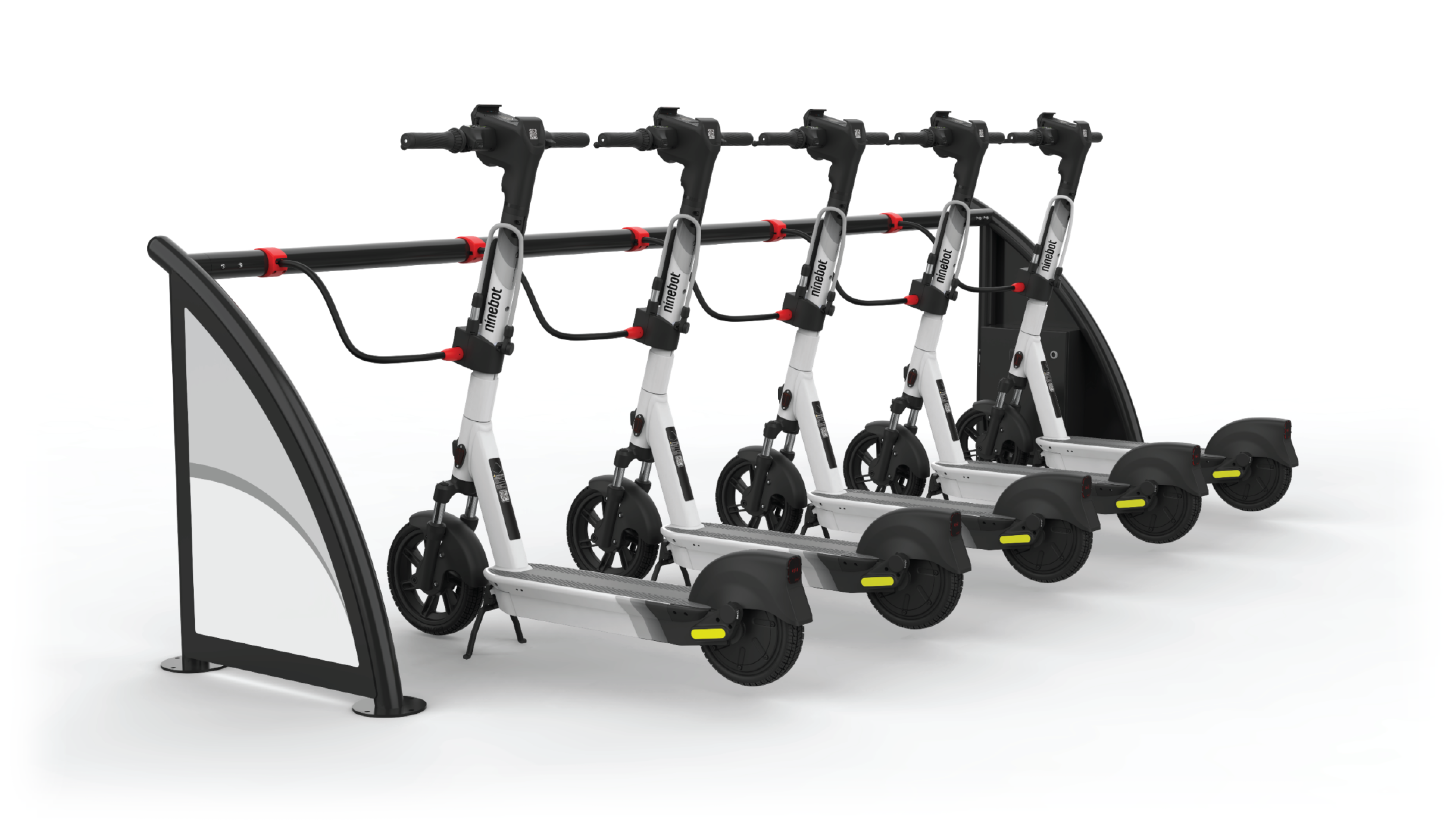
Designated return points make the intended parking location visible. At busy destinations, combining those return points with secure charging can address public-space management and fleet availability together. The design should preserve convenient access for riders while keeping pedestrian routes clear.
Charging and the cost of field operations
An available vehicle needs sufficient charge for the next trip. Where charging does not take place at the parking location, an operator must exchange the battery or move the vehicle to a charger. This requires staff time, transport, charging facilities, and coordination across the service area.
These activities create costs beyond the electricity consumed by the vehicle. Their scale depends on trip length, battery capacity, geography, and how frequently field staff need to intervene. A vehicle displayed in an app may contribute little useful availability if its battery is too depleted to rent.
Charging at return points changes that process by using the time between rentals to replenish batteries. NYC DOT’s May 2025 announcement describes grid-connected Citi Bike stations as a means of reducing manual battery exchanges by staff traveling in vehicles.NYC DOT charging expansion: the announcement identifies improved e-bike availability and reduced battery-swap vehicle travel as objectives.
This can reduce charging-related visits; it does not eliminate maintenance, inspections, or redistribution when trip patterns leave vehicles in the wrong places. Those activities should be measured separately when evaluating operational savings.
Secure parking and vehicle condition
How vehicles are stored between rentals affects both the public realm and fleet management. A defined, secure return point reduces the opportunity for a parked vehicle to tip into a pedestrian route or be moved away from its intended location. It also gives operators a predictable place to inspect and service the fleet.
Portland’s review of e-scooter parking options identified reduced clutter, theft, and vandalism among the potential benefits of lock-to systems. The review also noted that requiring locks would need to be accompanied by adequate parking supply.Portland parking analysis: the city’s assessment considers both the benefits of lock-to parking and the need to expand suitable parking locations.
App instructions, geofencing, and parking photographs can support compliance. Physical infrastructure performs a different function: it defines where the vehicle belongs and provides a means to secure it. The most useful combination depends on street conditions, available space, and the service model.
The operational benefit should be assessed through damage rates, vehicle losses, parking complaints, and the time required to resolve incidents. A charging station is not a substitute for durable vehicles or routine maintenance, but it can form part of a more controlled storage environment.
Targeted charging within a flexible network
A fleet does not necessarily need to charge at every permitted destination. A hybrid network can provide charging at selected locations while retaining other return options. Station placement should reflect where vehicles circulate, how long they remain parked, and where reliable availability matters most.
Published operator modeling illustrates the potential. In 2023, Lyft reported that electrifying 15–20% of Chicago’s stations could keep up to 80% of the fleet charged and reduce battery-swap costs by 80%.Lyft’s Chicago model: these are operator projections for a docked bike-share network, not measured results for all micromobility fleets.
In a presentation hosted by NYSERDA in 2025, Lyft also projected that electrifying high-ridership Citi Bike stations could reduce battery swaps by up to 90%.Lyft presentation at NYSERDA’s showcase: the New York estimate is a vendor model presented in the Clean Mobility slides, rather than an independent NYSERDA evaluation.
The estimates describe different outcomes: the proportion of vehicles kept charged, the cost of battery exchanges, and the number of exchanges avoided. They should not be treated as interchangeable measures or assumed to apply to a dockless scooter fleet. They do, however, provide a basis for testing whether a limited charging network can materially reduce field work.
For a local pilot, trip data can identify candidate sites near transit, housing, campuses, and other recurring destinations. Charging capacity and return incentives can then be tested against actual battery demand. The business case depends on whether the reduction in field operations justifies the installed cost and ongoing upkeep of the stations.
Evaluating performance beyond ridership
Ridership is an important measure of demand, but it does not fully describe the quality or cost of a shared fleet. A useful evaluation also records the proportion of vehicles available to rent, the frequency of battery exchanges, and the labor and transport required to maintain service.
Parking outcomes deserve similar attention. Obstruction complaints, response times, and repeat problem locations help establish whether a program is managing public space effectively. Vehicle damage and losses should be tracked alongside repair costs and service life.
A charging pilot should compare these measures before and after installation, accounting for changes in fleet size, trip volume, season, and service area. Cost per completed trip and staff visits per vehicle can help distinguish an operational improvement from a change caused mainly by lower demand.
The strongest case for infrastructure is a measurable improvement in service: more vehicles ready for use, fewer avoidable field visits, and clearer parking arrangements at a sustainable cost.
Integrating parking and charging
Integrated charging and locking stations offer a practical way to connect the end of one rental with preparation for the next. ChargeLock® is designed around this approach: compatible e-bikes and scooters lock and charge at the return point, with rental completion linked to docking.
The same principle can support a fully station-based program or a hybrid network with designated charging locations. The appropriate model depends on local travel patterns, parking constraints, and the degree of flexibility required by riders.
For smaller communities and property-based fleets, installation cost is especially important. Simpler infrastructure can make more locations feasible, provided that power supply, capacity, accessibility, and maintenance needs are addressed. Within a fixed infrastructure budget, a lower installed cost can allow more return points to serve the same community.
The central design question is how much routine work can be completed at the return point. Treating parking and charging as part of the service creates an opportunity to reduce recurring field operations while retaining the convenience that makes shared micromobility useful.